Introduction
Every parent remembers the excitement of their baby’s first word. Those early sounds feel like small miracles, and they are actually the building blocks of something much bigger: a child’s lifelong ability to communicate. Talking and understanding language shape how a child learns new things, builds friendships, expresses feelings, and makes sense of the world.
So what happens when those words come later than expected or don’t come at all?
Speech and language delays are far more common than most parents realize. Health experts estimate that nearly 1 in 12 children between the ages of 3 and 17 in the United States has some kind of disorder related to voice, speech, language, or swallowing. Similar patterns show up around the world, including right here in Pakistan, where speech and language concerns remain one of the most frequent reasons parents bring young children to a pediatrician or developmental specialist.
It’s easy to brush off a quiet toddler as simply “a late bloomer” or “shy like their father.” Sometimes that’s exactly what’s happening. But early speech and language problems that go unnoticed can quietly affect far more than just talking. They can shape how a child learns to read, how confident they feel in a classroom, how easily they make friends, and even how they behave when they’re frustrated.
The good news is that speech and language delays are some of the most treatable developmental concerns in early childhood, especially when they’re caught early. This guide is designed to walk you through everything a concerned parent needs to know: what speech therapy actually is, what normal speech development looks like at different ages, the ten most important signs that your child may need speech therapy, the common causes behind these delays, how professionals diagnose them, and simple things you can start doing at home today. By the end, you’ll have a clear, practical roadmap for understanding your child’s communication development and knowing exactly when it’s time to seek extra support.
What Is Speech Therapy?
Definition of Speech Therapy
Speech therapy, sometimes called speech and language therapy, is a type of treatment that helps children improve how they understand and use language, how clearly they pronounce sounds and words, and how confidently they communicate with others. Depending on a child’s needs, therapy can focus on spoken language, understanding of language, social communication, voice, fluency (such as stuttering), or even feeding and swallowing in some cases.
What Does a Speech-Language Pathologist (SLP) Do?
A speech-language pathologist, commonly known as an SLP or simply a “speech therapist,” is a trained healthcare professional who evaluates and treats communication disorders in both children and adults. An SLP observes how a child speaks, listens, understands instructions, and interacts socially, then builds a personalized therapy plan that targets the exact skills that need strengthening.
Who Needs Speech Therapy?
Not every child who talks a little differently needs professional help. Some children are simply late bloomers who catch up on their own with time and a bit of extra encouragement. However, children who fall noticeably behind expected milestones, who are difficult to understand even by familiar adults, or who show visible frustration around communicating usually benefit from a proper evaluation, even if it’s just for peace of mind.
Speech Disorders vs Language Disorders
Parents often use “speech” and “language” interchangeably, but they aren’t quite the same thing. A speech disorder affects how sounds are physically produced, for example, a child who says “wabbit” instead of “rabbit” or who stutters on certain words. A language disorder, on the other hand, affects a child’s ability to understand or use words and sentences to communicate meaning, for example, a child who struggles to follow directions or can’t form a complete thought. Many children experience some combination of both, which is exactly why a thorough evaluation matters.
Understanding Normal Speech and Language Development
Before deciding whether something is “wrong,” it helps to know what typical communication development generally looks like. Every child grows at their own pace, and these milestones are general guidelines rather than strict rules, but they give parents a useful reference point for noticing when something seems off track.
Speech Milestones at 12 Months
By their first birthday, most babies babble with changing tones that sound almost like real sentences, turn toward sounds and voices, respond to their own name, and may say one or two simple, meaningful words such as “mama,” “dada,” or “bye-bye.”
Speech Milestones at 18 Months
By 18 months, toddlers typically have a vocabulary of roughly 10 to 20 words, point to things they want or find interesting, and can follow very simple one-step instructions, such as “give me the cup” or “come here.”
Speech Milestones at 2 Years
By age two, most children begin combining two words into short phrases, like “more milk” or “go bye-bye,” have a vocabulary of 50 or more words, and can usually be understood by close family members most of the time, even if their pronunciation isn’t perfect yet.
Speech Milestones at 3 Years
By age three, children generally speak in short sentences of three to four words, ask simple questions like “where’s daddy,” and can be understood by people outside the immediate family most of the time.
Speech Milestones at 4–5 Years
By 4 to 5 years old, most children can tell a simple story with a beginning and an end, use longer and more grammatically correct sentences, and pronounce nearly all sounds correctly, with the exception of a few tricky sounds like “r,” “s,” or “th,” which can take a little longer to master.
Why Early Identification of Speech Delays Matters
Effects on Learning
Communication is the foundation almost everything else in early learning is built on. When speech or language is delayed, understanding new instructions, absorbing new vocabulary, and later learning to read can all become noticeably harder.
Effects on Social Skills
Children who struggle to express themselves clearly often find it harder to join group play, take turns in conversation, or simply make new friends, which can leave them feeling left out even when they desperately want to be included.
Effects on Emotional Development
When a child cannot reliably express their needs, wants, or feelings, frustration tends to build. Over time, this can quietly chip away at a child’s confidence and overall emotional well-being, especially if the frustration isn’t understood by the adults around them.
Effects on Academic Performance
A large body of research links early speech and language delays to later struggles in reading and writing, simply because spoken language skills are the foundation that literacy is built upon. Children who enter school with strong communication skills generally have an easier time keeping pace with their classmates.
10 Signs Your Child May Need Speech Therapy
If you’ve found yourself quietly comparing your child to other kids their age or wondering whether their talking is really “on track,” here are the ten most common signs that point toward a speech and language evaluation.
1. Your Child Is Not Meeting Speech Milestones
This is usually the very first thing parents notice. Warning signs include no babbling by around 12 months, no first meaningful words by 16 to 18 months, and no two-word phrases by age two. A single missed milestone isn’t necessarily a cause for alarm, but if your child consistently lags behind several markers at once, it’s worth bringing up with your pediatrician or a speech-language pathologist.
2. Your Child Has a Limited Vocabulary
Most toddlers go through a vocabulary explosion between ages 1 and 3, picking up new words almost daily. If your child’s word bank seems stuck at the same handful of words for months, or they rely heavily on pointing and gestures instead of actually saying words, this could be a sign of a language delay rather than simple shyness.
3. Your Child Is Difficult to Understand
Some unclear speech is completely normal in toddlers, since their mouths and tongues are still learning to coordinate. But if family members, teachers, or even you regularly struggle to understand most of what your child says past the age of three, it could point to an underlying speech sound disorder or articulation issue that benefits from professional support.
4. Your Child Has Difficulty Pronouncing Certain Sounds
Certain sounds, like “r,” “s,” “l,” and “th,” naturally develop later than others, so a bit of difficulty with these is expected and not a cause for concern on its own. However, if a child consistently substitutes, drops, or distorts sounds well past the age most children typically master them, a speech-language pathologist can correct these patterns early, before they become harder-to-break habits.
5. Your Child Does Not Follow Simple Instructions
If your child often seems confused by basic directions, like “put the toy in the box” or “bring me your shoes,” this might be more than just a distracted moment. It could point to a receptive language disorder, meaning the child has genuine difficulty understanding spoken language, rather than simply not paying attention.
6. Your Child Struggles to Form Sentences
Some children understand far more than they’re able to say. These kids may rely on single words or short, broken phrases long after their peers have moved on to full sentences. This pattern, often called an expressive language disorder, is a clear sign that a child could benefit from targeted language support.
7. Your Child Stutters Frequently
A small amount of repetition or hesitation is common while toddlers are still learning how to speak. But frequent stuttering, especially when it comes with visible tension, blocked sounds, or facial strain, or when it continues for more than six months, may point to a fluency disorder that responds well to early intervention.
8. Your Child Has Trouble Socializing and Communicating
Difficulty making eye contact, starting a simple conversation, or understanding the back-and-forth rhythm of talking with other children can be a sign of a social communication disorder. This is sometimes among the earliest signs that leads families toward a broader developmental evaluation, since social communication and language development are closely connected.
9. Your Child Gets Frustrated When Trying to Communicate
When children can’t find the words to express what they want, frustration often shows up as crying, tantrums, hitting, or simply pulling away from trying to talk altogether. A little frustration is part of normal toddlerhood, but persistent, intense frustration specifically tied to communication attempts is a meaningful sign worth paying attention to.
10. Your Child Suddenly Loses Speech Skills
Perhaps the most important sign on this entire list is regression, meaning a child who once had words, phrases, or social skills and then loses them. A sudden loss of previously acquired speech or social abilities should always be evaluated promptly by a professional, since it can sometimes be an early indicator of autism spectrum disorder or another underlying developmental or neurological condition.
Common Causes of Speech and Language Delays
There usually isn’t just one single cause behind a speech or language delay. More often, it’s a combination of factors working together.
- Hearing Loss: Even mild or partial hearing loss can make it genuinely difficult for a child to hear, distinguish, and imitate speech sounds correctly, which slows language learning from the very start.
- Autism Spectrum Disorder: Communication challenges, including delayed speech, limited eye contact, and difficulty with back-and-forth social interaction, are among the most common early signs associated with autism.
- Developmental Delays: Broader developmental delays often affect speech and language alongside motor skills, cognitive skills, or both, since these areas of development are closely linked.
- Neurological Disorders: Conditions that affect the brain or nervous system, such as cerebral palsy, can impact the muscle coordination needed for clear, controlled speech.
- Oral-Motor Problems: Weak coordination or strength in the lips, tongue, and jaw can make it physically harder for a child to form certain sounds, regardless of how well they understand language.
- Premature Birth: Babies born significantly early sometimes experience delays across several areas of development, including speech and language, often related to time spent in intensive care during critical early developmental windows.
- Genetic Conditions: Certain genetic syndromes carry a known, higher likelihood of speech and language difficulties as part of their broader developmental profile.
- Environmental Factors: Limited language exposure at home, excessive passive screen time, or minimal back-and-forth conversation can also meaningfully slow down a child’s natural speech development.
Speech Delay vs Language Delay – What’s the Difference?
What Is Speech Delay?
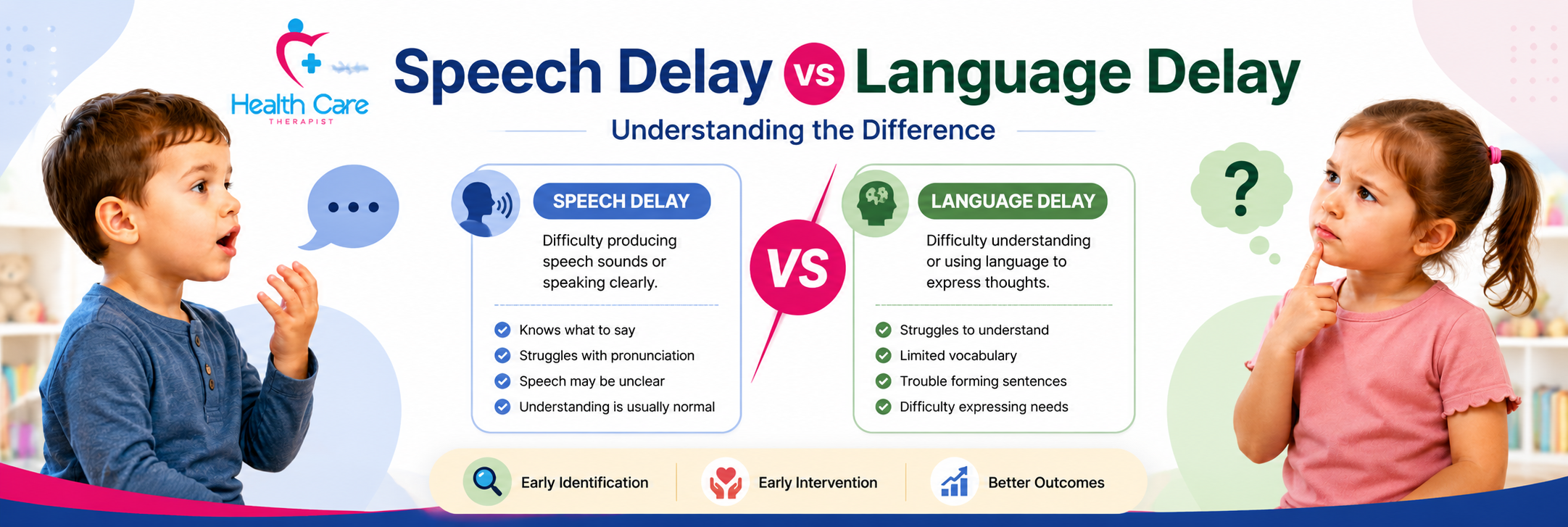
A speech delay means a child’s ability to physically produce sounds and words is behind what’s typically expected for their age, even though they may understand spoken language perfectly well.
What Is Language Delay?
A language delay means a child has trouble understanding spoken language (called receptive language) or using words and sentences to express themselves (called expressive language), regardless of how clearly they’re able to pronounce individual sounds.
Signs of Each Condition
A child with a pure speech delay might understand everything said to them but be genuinely hard to understand when they talk back. A child with a language delay, on the other hand, might pronounce words perfectly clearly but use far fewer words or much shorter sentences than expected, or struggle to follow along in everyday conversations.
Can a Child Have Both?
Yes, and in fact this is fairly common. Many children experience overlapping speech and language delays at the same time, which is exactly why a comprehensive evaluation by a qualified speech-language pathologist is so valuable. It identifies precisely which areas need support, rather than guessing.
At What Age Should Parents Worry About Speech Delay?
Red Flags at 12 Months
No babbling at all, no gestures like waving or pointing, and no response when their name is called by around 12 months are worth mentioning to your child’s doctor at the next check-up.
Red Flags at 18 Months
Fewer than 10 to 15 words, no attempts to imitate sounds or words, or no pointing to ask for things by 18 months are signs that deserve closer monitoring.
Red Flags at 2 Years
Not yet combining two words together, a vocabulary smaller than roughly 50 words, or being mostly unintelligible even to parents by age two are reasonable grounds to seek a professional evaluation.
Red Flags at 3 Years
Speech that’s still very hard for most people to understand, an inability to form three-word sentences, or trouble answering simple questions like “What’s your name?” by age three are meaningful red flags.
Red Flags at 4–5 Years
Frequent grammar errors well beyond what’s typical for the age, ongoing difficulty being understood by people outside the family, or trouble telling even a simple, short story by age four or five should prompt a professional evaluation rather than a “wait and see” approach.
How Speech and Language Delays Are Diagnosed
Speech Evaluation
A speech-language pathologist listens closely to how a child produces individual sounds, words, and full sentences in order to pinpoint specific articulation or fluency issues.
Language Assessment
Standardized tests, combined with structured play-based activities, help measure how well a child understands and uses language compared to other children their age.
Hearing Assessment
Since undiagnosed hearing problems are a common hidden cause of speech delay, many evaluations begin with a hearing check by an audiologist to rule this out as a contributing factor.
Developmental Screening
A broader developmental screening looks beyond speech alone, examining motor skills, cognitive skills, and social behavior to determine whether the delay is isolated or part of a wider developmental pattern.
Parent Interviews
Parents are often the single best source of information about a child’s communication history. Because of this, SLPs typically spend significant time asking detailed questions about early milestones, daily behavior, and how the child communicates at home.
How Speech Therapy Helps Children
Improves Communication Skills
Therapy strengthens both sides of communication: understanding what others say and clearly expressing one’s own thoughts, needs, and feelings in return.
Improves Vocabulary
Structured, play-based activities help children learn new words faster and, just as importantly, learn how to use those words correctly in different everyday situations.
Improves Pronunciation
Targeted exercises retrain the muscle movements and sound patterns a child needs to produce clearer, more accurate, and more easily understood speech.
Improves Social Skills
Many therapy programs weave in social communication practice, helping children learn to take turns, recognize social cues, and join conversations with confidence rather than hesitation.
Improves Confidence
As a child’s communication skills improve, the daily frustration of being misunderstood naturally decreases, and self-esteem tends to grow both at home and in social settings like school or playdates.
Supports School Readiness
Strong speech and language skills are directly tied to reading readiness, classroom participation, and long-term academic success, making early therapy a meaningful investment in a child’s future.
Speech Therapy Activities Parents Can Practice at Home
You don’t have to wait for a formal therapy session to start supporting your child’s communication. A few simple daily habits can make a genuine difference.
- Reading Books Together: Reading aloud every day exposes children to new vocabulary, sentence structure, and the natural rhythm of language, even before they can read on their own.
- Naming Objects: Narrating everyday moments out loud, such as “now we’re washing the apple,” helps children connect spoken words to the things and actions around them.
- Singing Songs: Familiar songs and nursery rhymes naturally encourage repetition, rhythm, and playful sound practice without feeling like “work.”
- Turn-Taking Games: Simple games that require waiting for a turn and responding build the same back-and-forth pattern that real conversation depends on.
- Expanding Sentences: If your child says “more juice,” gently respond with “you want more juice, please,” modeling a fuller, more complete sentence without correcting or criticizing.
- Limiting Excessive Screen Time: Reducing passive screen time in favor of real, face-to-face conversation gives children far more natural opportunities to practice both speaking and listening.
What Happens If Speech Delays Are Left Untreated?
Academic Difficulties
Children who enter school with unresolved speech or language delays often struggle to keep up with reading, writing, and following classroom instructions at the same pace as their peers.
Social Isolation
Ongoing difficulty communicating can make it harder to form friendships, sometimes leading to withdrawal, social anxiety, or even exclusion by other children.
Behavioral Problems
Persistent communication frustration frequently shows up as tantrums, aggression, or acting out, particularly in young children who haven’t yet developed other ways to express what they’re feeling.
Low Self-Esteem
Repeated experiences of being misunderstood, corrected, or unable to keep up with same-age peers can quietly chip away at a child’s confidence over time.
Long-Term Communication Challenges
Without timely intervention, some speech and language difficulties can persist well into adolescence and adulthood, potentially affecting everything from classroom participation to job interviews and personal relationships later in life.
When Should You Consult a Speech Therapist in Lahore?
Signs You Should Seek Professional Help
If your child shows two or more of the ten signs covered earlier in this guide, particularly missed milestones, frequent frustration around talking, or any sudden loss of speech skills, it’s a good time to book a proper evaluation with a qualified, certified speech-language pathologist.
What to Expect During the First Visit
A first visit to a speech therapist in Lahore typically includes a detailed conversation about your child’s developmental history, a series of play-based assessment activities designed to feel natural and unthreatening to the child, and a clear discussion of next steps, whether that means ongoing therapy sessions, a referral for a hearing check, or simply a plan to monitor progress over the coming months.
Benefits of Early Intervention
Families searching for trusted, personalized speech therapy services in Lahore can take real comfort in the fact that early intervention programs consistently show the strongest, most lasting outcomes. The earlier a delay is correctly identified and addressed by an experienced pediatric speech therapist, the more effectively a child is able to catch up to their peers and build lifelong communication confidence.
Frequently Asked Questions
How do I know if my child needs speech therapy?
If your child is consistently missing speech and language milestones for their age, is difficult for most people to understand, or shows ongoing frustration when trying to communicate, it’s a good idea to have them evaluated by a certified speech-language pathologist.
At what age should a child start speech therapy?
There’s no strict minimum age. Speech therapy can begin as early as 18 months to 2 years old once a delay is identified, and research consistently shows that earlier intervention generally leads to faster, stronger progress.
Can speech delay resolve on its own?
Some mild delays do improve naturally as a child grows, especially when there’s no underlying disorder involved. However, persistent or more significant delays usually require professional support to fully resolve and prevent long-term impact.
Is speech delay a sign of autism?
Speech delay can be one early sign associated with autism spectrum disorder, but it can also occur entirely on its own without any connection to autism. A full developmental evaluation is the best way to clarify the underlying cause.
How long does speech therapy take?
The length of treatment varies widely depending on a child’s specific needs, ranging anywhere from a few months for mild articulation issues to a few years for more complex language disorders.
Can parents do speech therapy at home?
Parents can absolutely reinforce progress at home through reading, naming objects, and conversation-rich daily activities. That said, these efforts should complement, not replace, professional therapy whenever a genuine delay has been identified.
Does screen time affect speech development?
Excessive passive screen time can reduce the natural opportunities children need for real conversation and back-and-forth interaction, both of which are essential for healthy speech and language development.
How often should a child attend speech therapy sessions?
Most children attend speech therapy once or twice a week, though the exact frequency depends on the severity of the delay and the specific recommendations of the treating speech-language pathologist.
What is the difference between speech delay and language delay?
Speech delay affects how clearly a child physically produces sounds and words, while language delay affects how well a child understands or uses words and sentences to communicate meaning.
What are the first signs of communication disorders?
Early signs often include limited or absent babbling, few or no words by 18 months, ongoing difficulty following simple instructions, and noticeable frustration whenever the child tries to communicate.
Final Thoughts
Recognizing the signs that your child may need speech therapy is one of the most valuable things you can do as a parent. Speech and language delays are common, highly treatable, and far easier to address the earlier they’re identified. If something about your child’s communication has felt “off” for a while, trust that instinct. Talk to your pediatrician, ask questions, and consider a professional evaluation from a qualified, experienced speech-language pathologist. With the right support at the right time, most children make remarkable progress, building the communication skills and confidence that will stay with them for life.